When headlines announce an interest rate decision in Washington or new economic data from Beijing, it’s easy to assume those stories are for economists, politicians or financial professionals. After all, they’re happening thousands of kilometres away.
So why do they so often make the front page in South Africa?
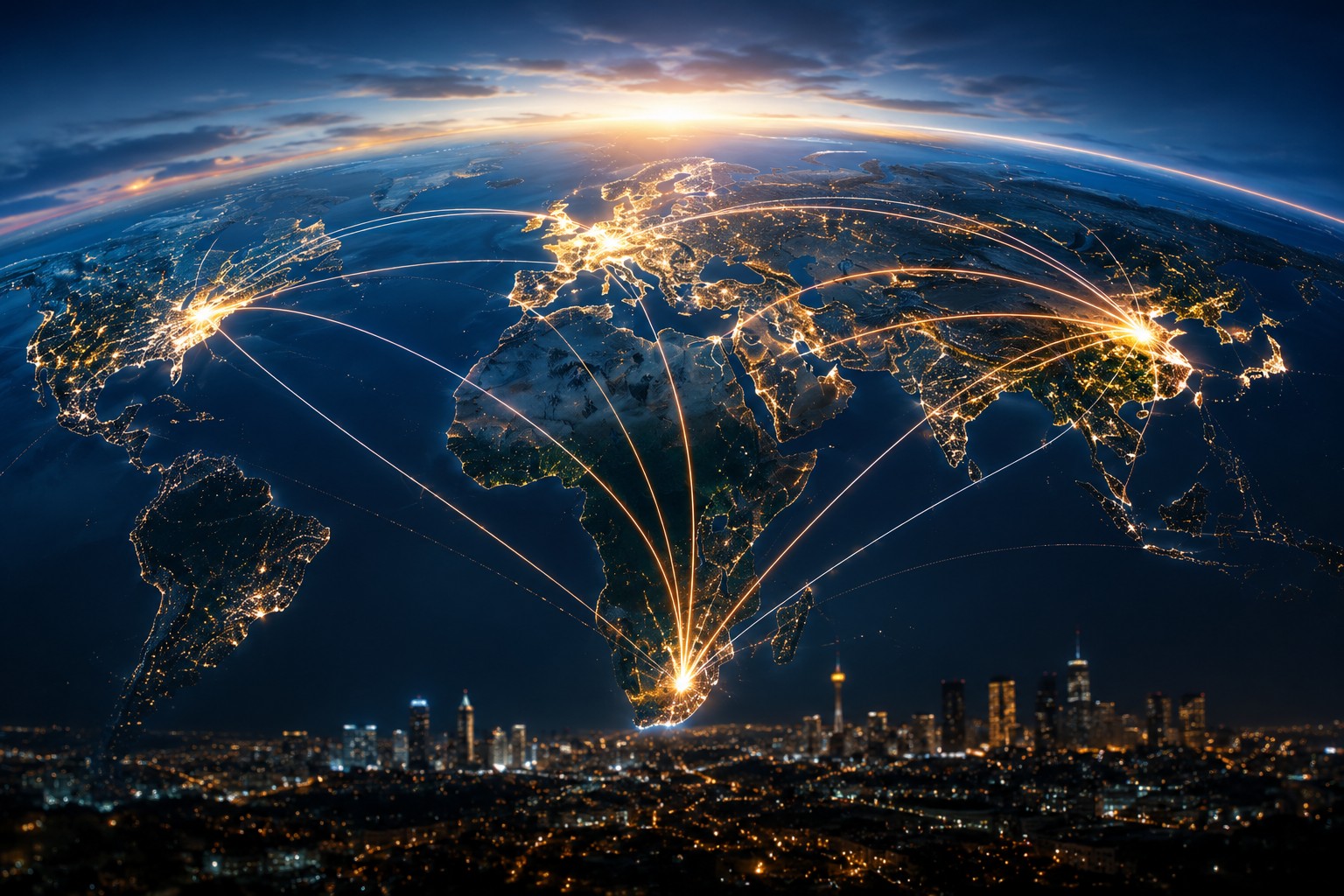
The answer lies in something that has quietly transformed the world over the past few decades: our economies have become deeply connected. Goods, services, money, technology and information move across borders faster than ever before, meaning decisions made in one part of the world can have consequences far beyond their own shores.
In today’s global economy, what happens in Washington or Beijing doesn’t stay there. It can influence businesses in Johannesburg, manufacturers in Gqeberha, farmers in the Free State and consumers in Cape Town.
The World Is More Connected Than Ever
Think about your morning routine.
Perhaps you check your phone, made with components sourced from several countries and assembled in another. You drive to work using fuel whose price is influenced by global oil markets. You buy coffee grown in South America, tea from Kenya or electronics manufactured in Asia.
Our daily lives are shaped by a global network that stretches far beyond our borders.
The same is true for businesses. South African companies sell products around the world, import machinery and technology, borrow money, work with international partners and compete in a global marketplace.
When one part of that network changes, the effects often ripple across the entire system.
Why Washington Matters
The United States remains the world’s largest economy, and its decisions often influence global economic conditions.
When the US Federal Reserve adjusts interest rates, for example, the effects are rarely limited to America. Higher or lower borrowing costs can influence global financial conditions, currencies and business confidence, particularly in emerging markets. Research has shown that changes in US monetary policy can have significant spillover effects across the global economy.
It’s a little like changing the temperature in the engine room of a large ship. Passengers in other parts of the vessel may not see what’s happening, but they’ll still feel the difference.
Trade policy is another example.
When the United States changes tariffs or trade rules, businesses around the world often rethink where they manufacture products, source materials or sell goods. Those decisions can reshape global supply chains, creating both challenges and opportunities for countries like South Africa.
Why Beijing Matters
If Washington is an economic powerhouse, Beijing is the world’s manufacturing engine.
China is South Africa’s largest trading partner, buying significant quantities of minerals and raw materials while supplying everything from electronics to household goods.
When China’s economy grows strongly, demand for commodities often increases. When growth slows, that demand can soften.
For South Africa, where mining remains an important part of the economy, developments in China can influence export activity, industrial production and business confidence.
But China’s influence extends beyond commodities.
Many of the products used every day, from smartphones and solar panels to household appliances and vehicle components, pass through Chinese factories or supply chains before reaching consumers around the world.
In many ways, China has become one of the world’s workshops.
The Domino Effect
Imagine knocking over the first domino in a long line. The first tile may be in another country, but eventually the movement reaches the last one.
Global economies often work in a similar way.
A drought in one region can affect food supplies elsewhere. A shipping disruption can delay products thousands of kilometres away. A conflict affecting energy supplies can influence transport costs around the world. One country’s policy decision can encourage businesses to move factories, change suppliers or rethink future investments. None of these events happens in isolation.
What This Means for South Africa
South Africa is often described as an emerging market, but it’s also a globally connected economy. We export minerals, agricultural products, manufactured goods and services. We import technology, machinery, fuel and countless consumer products. That means international developments can eventually influence everyday life in ways that aren’t always obvious.
A shift in global shipping routes can affect delivery times. Changes in commodity demand can influence industries that employ thousands of South Africans. Movements in global energy markets can filter through to transport and logistics costs. Even international confidence can shape how businesses think about expansion, hiring and investment.
The International Monetary Fund has noted that growing trade tensions and global policy uncertainty can affect open economies like South Africa by disrupting supply chains, changing trade patterns and influencing economic growth.
Why the News Can Feel So Global
It isn’t only because the world has become more connected. It’s because information now travels almost instantly. A policy announcement made in Washington can be discussed in Johannesburg within minutes. Economic data released in Beijing can influence conversations in boardrooms across the globe before lunchtime.
News no longer moves at the speed of tomorrow’s newspaper. It moves at the speed of a notification.
A Two-Way Relationship
It’s worth remembering that this relationship isn’t one-sided.
South Africa also plays an important role in the global economy. Our mineral resources support industries around the world. Our financial markets are among the most developed on the African continent. Our agricultural exports reach international consumers, while our ports connect global trade routes.
In an interconnected world, every country is both influenced by global events and contributes to them.
The Bigger Picture
It’s easy to look at international headlines and wonder why they matter to us. But the reality is that today’s economy is less like a collection of separate countries and more like a network of connected cities. What happens in one place can affect another, not because countries are the same, but because they’re connected through trade, technology, finance and people.
Understanding these connections doesn’t require an economics degree. It simply reminds us that the world is smaller than it once seemed.
The next time a major announcement comes from Washington or Beijing, it may still feel far away. But chances are, the story has already begun its journey to Johannesburg.