


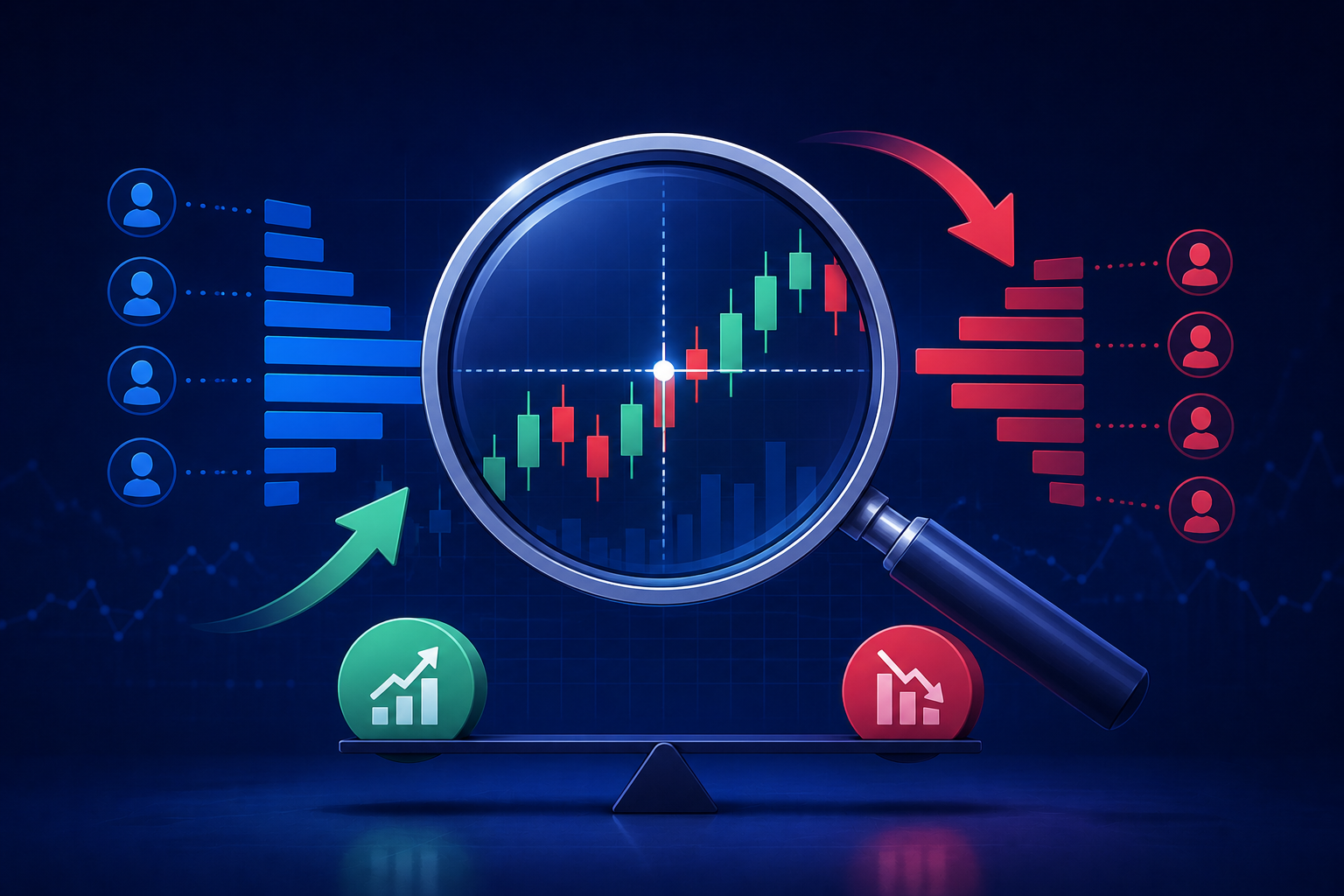
Ever wondered who decides the value of a share on the open market? Beyond company fundamentals, such as revenue, growth outlook and competitive advantage, factors such as investor sentiment, liquidity and price discovery also influence share prices.
In an open market, share prices fluctuate as investors respond to new information, including economic data, global events, company earnings reports and changing expectations about a stock’s potential future value.
When investors absorb and act on this information, their buying and selling decisions help determine the market price of a share — the price at which a willing buyer and a willing seller agree to transact.
As new information emerges, investors constantly reassess what they think a stock is worth and adjust their buying or selling behaviour accordingly.
This process is known as price discovery. It relies heavily on supply and demand and seeks to establish a price at which buyers and sellers are willing to trade.
Supply and demand dynamics
Understanding price discovery can help DIY investors make more informed trading decisions by providing greater clarity about why their preferred stocks move.
The goal of price discovery is not to find one permanent, exact price, but to continuously reflect the price level at which buyers and sellers are prepared to transact under current market conditions.
If demand rises relative to supply, the price tends to move up. If supply rises relative to demand, the price tends to move down.
The order book: How market trading happens
Behind the scenes of many trading platforms is the order book: a real-time list of limit orders, with buyers stating the maximum price they are willing to pay (bids) and sellers stating the minimum price they are willing to accept (asks).
In order-driven markets, a matching engine automatically executes trades when compatible buy and sell orders meet.
The difference between the highest bid and the lowest ask is the bid-ask spread. When new information enters the market, buyers and sellers adjust their bids and asks, and the price “discovers” a new level.
In some markets, a market maker – typically a financial institution or specialised trading firm – facilitates trading by continuously quoting both bid and ask prices for a given asset. By standing ready to buy and sell at publicly quoted prices, market makers provide important liquidity to the market, though prices can still change as conditions shift.
In popular, highly liquid stocks, such as Nvidia (NVDA: NASQ), Apple (AAPL: NASQ) and Amazon (AMZN: NASQ), large volumes of shares trade regularly. Price discovery in these stocks is generally efficient because the bid-ask spread is often narrow.
However, in small-cap or lesser-known stocks, there may be fewer buyers and sellers. This less liquid environment can make price discovery less efficient, and a single large buy or sell order can move the share price sharply.
Price discovery can also occur in over-the-counter (OTC) markets. In decentralised markets, buyers and sellers often negotiate privately, and prices may be discovered through dealer or requested quotes rather than through a central public order book.
Market participants may also trade through auction mechanisms, such as opening and closing auctions on exchanges, where orders are matched at a price that balances supply and demand at a specific point in time.
Finding fair value
In the open market, price discovery indicates what a stock is worth at a particular moment according to the collective actions and expectations of market participants.
Effective price discovery supports fair, transparent and liquid markets. It helps reduce mispricing and gives investors a clearer sense of whether an asset may be overvalued, undervalued or fairly valued based on available market information.
However, the market is not always right. As a DIY investor, it is vital to assess a stock’s intrinsic value. If the market temporarily prices a strong company at $50 because of short-term panic, but your research suggests it is worth $80, the gap may represent a buying opportunity.









