


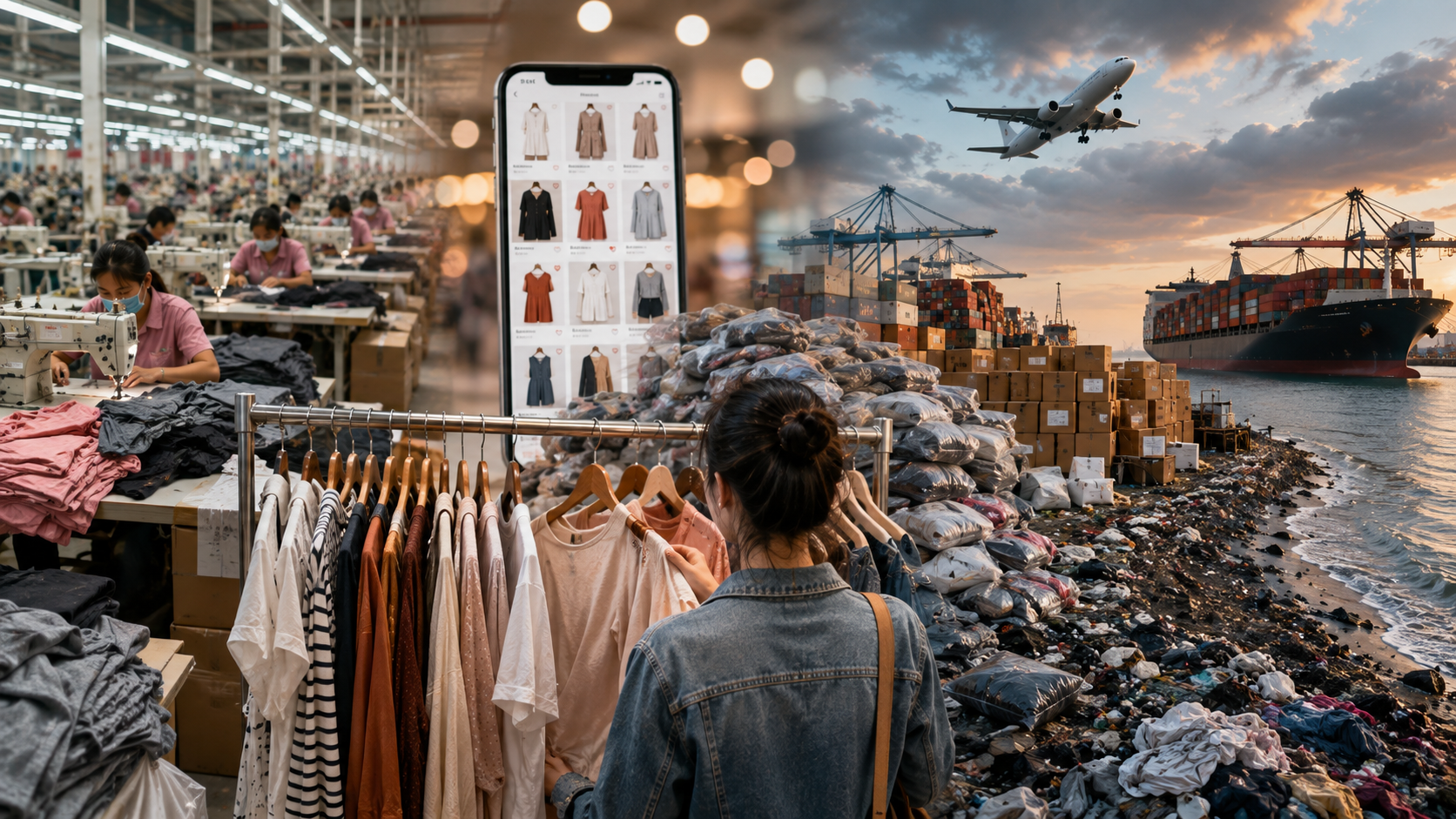
A t-shirt can cost less than lunch.
A dress can appear online, go viral, be manufactured, shipped halfway around the world and arrive at someone’s door while the trend that inspired it is still circulating on social media.
That feels almost impossible.
Yet it has become normal.
Fast fashion is often discussed as a story about clothing, trends or sustainability. Look a little closer, though, and it becomes something much more interesting: a story about technology, global trade, consumer psychology, logistics, tariffs and one of the most finely tuned supply chains in modern retail.
And right now, some of the economics that made ultra-cheap fashion possible are beginning to change.
How did clothes become so cheap?
For most of fashion’s history, producing a new collection took months.
Designers created garments, manufacturers produced them in large quantities, retailers shipped them to stores and customers eventually decided whether they wanted them.
The risk was enormous. Get the trend wrong and warehouses could fill with unsold clothes.
Fast fashion changed that model by shortening the cycle between the runway, the factory and the shop floor. Then ultra-fast fashion pushed it even further.
Companies such as Shein built systems designed around extraordinarily rapid product testing. Instead of making huge quantities of every design, a platform can introduce many styles in small batches, watch what customers click on and buy, and quickly increase production of the items that catch on.
Research from Stanford published in 2026 found that ultra-fast-fashion businesses have become particularly sophisticated at the design stage. They use data, machine learning and information gathered from online trends to generate and test huge numbers of products rapidly. The breakthrough is not simply sewing clothes faster; it is identifying what consumers might want before committing to large production runs.
That changes the economics dramatically.
A retailer does not have to predict fashion perfectly six months in advance. It can watch demand forming almost in real time.
Fashion has effectively borrowed a principle from the technology industry: launch, measure, learn and adjust.
The smartphone became the shop window
Fast fashion’s rise also coincided with another major change.
Shopping moved onto the phone.
The traditional fashion store has limited floor space. An app does not.
Online platforms can present an almost endless stream of new products, change recommendations for each shopper and immediately see which colours, styles and prices attract attention.
This matters because fashion has always been driven by novelty. What digital retail did was massively increase the speed at which novelty could be delivered.
McKinsey estimates that the global fashion industry was worth around US$1.7 trillion in 2023, while more than 300 million people work somewhere across the clothing value chain. Its research also highlights just how quickly ultra-fast fashion expanded: by 2023, Shein was reportedly introducing as many as 10,000 designs a day, with an average item price substantially below older fast-fashion competitors.
The result is not merely cheaper clothing.
It is a completely different rhythm of consumption.
Instead of waiting for spring or summer collections, consumers can encounter something new every time they refresh an app.
Cheap clothing depends on expensive complexity
There is an irony at the heart of fast fashion.
The final product can be remarkably cheap, but the system required to deliver it is extraordinarily sophisticated.
Factories must respond quickly. Data has to flow between retailers and suppliers. Global payment systems need to work seamlessly. Warehouses must process huge numbers of individual orders. Airlines, ships, trucks and courier networks have to move small parcels rapidly across borders.
All of this has to happen while keeping the final price low enough to preserve the appeal of the product.
That is why tariffs and customs rules matter so much.
For years, one important feature of global e-commerce was the de minimis system used in several major markets. These rules allowed low-value parcels to enter countries with reduced customs requirements or without the duties that might normally apply to larger commercial shipments.
For a business sending millions of inexpensive individual parcels directly to consumers, that could be enormously significant.
Now those rules are changing.
Governments have started looking at the parcels
In the United States, duty-free de minimis treatment was suspended for qualifying low-value commercial shipments in 2025 and remains suspended in 2026. Goods that once entered under the exemption are now subject to the applicable customs processes and charges.
Europe has also changed its approach. From 1 July 2026, the European Union introduced a temporary €3 customs duty per item on qualifying low-value imports of up to €150, ahead of broader customs reforms. The European Commission says the changes are intended to respond to the extraordinary growth of low-value e-commerce and create more equal conditions between overseas sellers and European businesses.
These may sound like obscure customs decisions.
For fast fashion, they strike much closer to the heart of the business model.
If the economics of shipping a R100 or R200 item directly across the world change, companies have to reconsider pricing, logistics and where products are manufactured or stored.
Stanford researchers modelling these changes found that higher tariffs can affect not just prices but also how frequently ultra-fast-fashion firms launch products and how much variety they offer. Their research also suggests firms may respond by diversifying markets or eventually reconsidering parts of their production networks.
A customs rule can therefore ripple all the way back to the design studio and factory floor.
South Africa is part of the same story
South African retailers have been watching this shift closely.
The arrival of global e-commerce platforms gave local consumers access to enormous product ranges and exceptionally low prices, but it also raised questions about whether imported parcels and locally sold clothing were operating under comparable tax and customs conditions.
SARS acknowledged those concerns in 2024, specifically noting complaints that some low-value e-commerce clothing imports had benefited from customs treatment that created unequal competition with other industry participants.
The issue has continued to evolve. In May 2026, SARS and the National Consumer Commission signed an agreement to strengthen cooperation around non-compliant imports, customs compliance and consumer protection.
That makes fast fashion relevant to South Africa in several ways at once. It is a consumer story, but also a customs story, a retail competition story, a logistics story and a local manufacturing story.
What looks like a cheap dress on a screen sits at the end of a much larger economic debate.
Then there is the psychology
Price is only part of fast fashion’s success.
The other part is urgency.
Fashion has always relied on the desire for something new, but digital platforms can amplify that instinct dramatically.
A constantly changing catalogue creates the feeling that there is always something else to discover. Social media accelerates trends. Influencers compress the time between seeing a style and wanting it. Recommendation systems make shopping feel personalised.
And because individual items are relatively inexpensive, the decision can feel less significant.
That creates an unusual consumer dynamic. A R150 purchase might require very little deliberation, but a large number of R150 decisions can collectively create an enormous industry.
This is one reason fast fashion connects so naturally with the economics of FOMO. Novelty, scarcity and social proof can make products feel temporarily important even when their useful life may be short.
The cost that isn’t on the price tag
The low retail price of fast fashion has also created another economic debate: who pays for costs that are not included on the receipt?
The United Nations Environment Programme says the textile industry accounts for an estimated 2% to 8% of global greenhouse-gas emissions and consumes enormous amounts of water. UNEP also estimates that the world produces around 92 million tonnes of textile waste every year. Clothing production doubled between 2000 and 2015, while the average duration of garment use fell by 36%.
These are what economists sometimes call external costs.
A product’s price captures the fabric, labour, shipping and retail margin. It may not fully capture pollution, water use, waste disposal or other impacts created elsewhere in the system.
That helps explain why governments are becoming more interested in how clothing is produced, imported, sold and eventually discarded.
Interestingly, South Africa is already part of this transition. UNEP has worked with local textile manufacturers, including a Cape Town facility associated with Cape Union Mart, to measure and reduce environmental impacts in clothing production.
The future of fashion may therefore involve competition not only over who can make something cheapest, but over who can make supply chains more efficient, transparent and less wasteful.
The model is being tested
None of this means fast fashion is disappearing.
Far from it.
Consumers remain highly price-conscious, and McKinsey’s 2026 fashion outlook says the mid-market has become an increasingly important source of industry growth as shoppers focus more intensely on value. At the same time, tariffs, changing trade rules, AI and shifting consumer priorities are forcing fashion companies to rethink how their global systems operate.
That is what makes this such an interesting economic story.
Fast fashion was built around removing friction.
Make the design process quicker.
Make manufacturing more responsive.
Make shopping instantaneous.
Make delivery inexpensive.
Make the buying decision feel small.
Now, some of that friction is returning through customs duties, regulation, sustainability requirements and changing trade policies.
The question is not simply whether people will continue buying inexpensive clothing.
It is how an industry built around relentless speed adapts when the world around it becomes more complicated.
More than a t-shirt
Pick up an inexpensive t-shirt and it is tempting to see exactly that: a t-shirt.
But hidden inside the price is a remarkable global system.
There is data analysing what people want. There are factories adjusting production. There are workers, warehouses and logistics networks. There are customs rules determining how parcels cross borders. There are algorithms deciding which garment appears on which screen. There are governments reconsidering how global e-commerce should be regulated.
And increasingly, there is a debate about the environmental and social costs that the price tag does not show.
Fast fashion may look like one of the simplest products in the modern economy.
Its economics are anything but.









