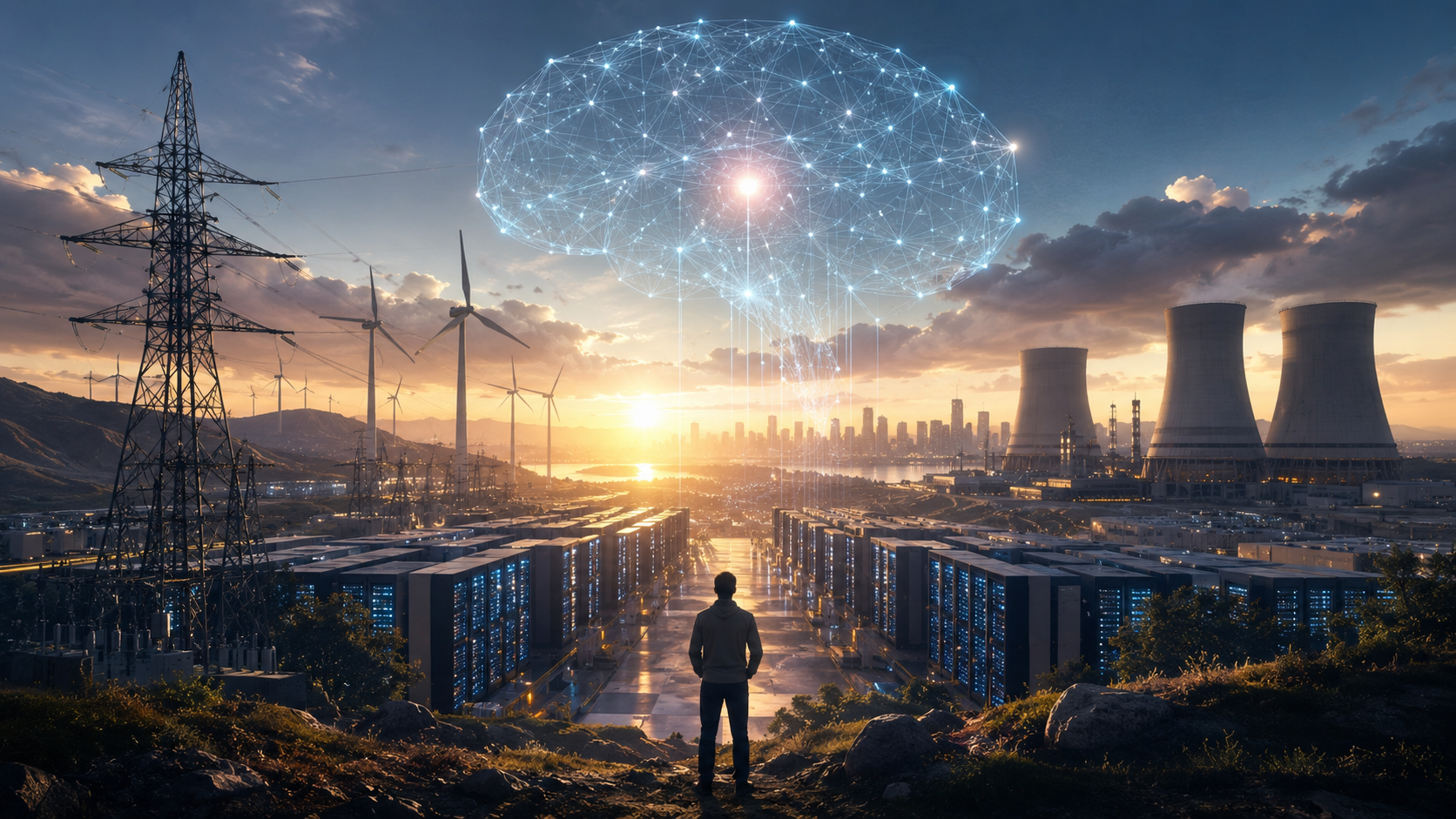
Artificial intelligence often feels almost weightless.
You type a question, a response appears, an image is generated or a document is summarised. It all happens in seconds, and because it happens on a screen, it can feel as though AI simply exists somewhere in the cloud.
But the cloud is not really a cloud.
It is land, steel, concrete, chips, cooling systems, electricity, power lines and enormous amounts of capital.
And that is where the AI story is becoming much more interesting.
The biggest question is no longer only whether artificial intelligence can become more powerful. It is whether the world can afford to build everything that powerful AI requires.
The digital revolution has become a construction project
For years, the technology industry was associated with software.
One of software’s great advantages was that once a product had been created, it could often be distributed to millions of users without needing to build millions of physical products.
AI is changing that equation.
Training and running advanced AI systems requires huge amounts of computing power. That computing power lives inside data centres filled with specialised processors, networking equipment and cooling infrastructure. Those facilities need buildings, electricity connections, backup systems, land, transformers and increasingly sophisticated energy infrastructure.
In other words, one of the most important technology races in history is becoming a race to build physical infrastructure.
And the bill is getting very large.
The International Energy Agency reported that capital expenditure by five of the world’s largest technology companies exceeded US$400 billion in 2025 and is expected to rise sharply in 2026, driven largely by spending on data centres and AI infrastructure.
That is no longer ordinary technology spending. It is infrastructure spending on a scale more commonly associated with railways, highways and energy systems.
Suddenly, everyone needs a data centre
The reason is simple: AI needs computation.
More sophisticated models generally require enormous amounts of processing during development, while millions of people using those systems create a second layer of demand once the technology is deployed.
That demand is already changing the electricity system.
The IEA estimates that global data-centre electricity consumption could roughly double from around 485 terawatt-hours in 2025 to approximately 950 terawatt-hours by 2030. AI-focused data centres are expected to grow even faster, with their electricity use potentially tripling over the same period.
Even the machines themselves are becoming remarkably power-hungry. The IEA estimates that by 2027, a single advanced server rack could have peak electricity demand comparable with about 65 households.
Multiply that across enormous data-centre campuses and the challenge becomes clear.
The AI race is not simply about who has the smartest model. It is increasingly about who can find enough electricity to run it.
Electricity may be the real bottleneck
This creates a strange situation.
A company may have the money, the chips and the land, and still be unable to build the data centre it wants because the local grid cannot supply enough power.
Connecting major facilities to power networks can take years. Transformers and other grid equipment can have long manufacturing lead times, while some regions simply do not have enough spare electricity capacity in the right place.
That is why technology companies are becoming more deeply involved in parts of the economy that once seemed far removed from software. They are signing long-term electricity agreements, backing renewable-energy projects, looking at nuclear power, investing in battery storage and working more closely with utilities and grid operators.
The world’s AI companies are effectively becoming some of the world’s most demanding energy customers.
The IEA expects renewable energy to supply a large share of the additional electricity required by data centres, although natural gas, nuclear and other sources are also likely to play a role depending on the region.
The digital economy still depends very heavily on the physical one.
Then comes the financing question
For the largest technology companies, enormous cash flows have helped fund the first phase of the AI build-out.
But infrastructure spending is becoming so large that balance sheets alone may not be enough.
That is starting to change how the AI race is financed.
The Bank for International Settlements says major technology companies have increasingly turned to debt markets as capital expenditure has climbed. Gross bond issuance by large hyperscale technology companies exceeded US$100 billion in 2025, with much of that borrowing used to support long-term infrastructure projects.
The Bank of England has also highlighted the growing role of debt and private capital in financing data-centre expansion, noting that more than half of the external financing required for global data-centre investment between 2026 and 2028 could ultimately come from debt.
That means AI is increasingly linked not just to stock markets, but also to credit markets, banks, private lenders and infrastructure capital.
The AI race is becoming a financing story as much as a technology story.
There is an awkward problem with borrowing for AI
Infrastructure usually makes sense when the asset being financed lasts for a long time.
A road might operate for decades. A power station may remain useful for generations. A data-centre building could also last for many years.
But the equipment inside it can become outdated much faster.
AI chips are improving at extraordinary speed. A processor considered cutting-edge today may be considerably less competitive only a few years from now.
That creates an unusual financial challenge.
Long-term debt may be funding infrastructure whose technological usefulness changes much sooner than the building itself.
The Bank of England has specifically highlighted this mismatch, noting that while data-centre buildings may have long economic lives, the chips and equipment inside them can depreciate much faster. JP Morgan estimates cited by the Bank suggest that more than US$2 trillion of funding could be required for AI chips over the next five years alone.
That does not mean those investments will fail. It simply makes the economics more complicated.
AI infrastructure is expensive to build, while the technology it supports is evolving exceptionally quickly.
What if AI gets more efficient?
There is another fascinating twist.
The technology industry is constantly trying to make AI cheaper to run. New chips use electricity more efficiently, models improve and software becomes more optimised.
You might assume that this would reduce total electricity demand.
It might.
But history suggests another outcome is also possible.
When technology becomes cheaper and easier to use, people often use much more of it.
Cars became more efficient, yet driving increased. Computers became cheaper, yet computing exploded. Internet bandwidth became less expensive, and global data consumption soared.
AI could follow the same pattern.
The energy required for an individual task may fall while the number of AI tasks grows dramatically.
That is one reason electricity demand from the sector can continue rising even while AI itself becomes more efficient.
Why Nvidia’s results matter beyond Nvidia
This is also why markets pay so much attention when companies at the centre of the AI ecosystem report results.
Nvidia’s earnings are closely watched not simply because it is a very large company, but because its processors sit near the beginning of the AI infrastructure chain.
Demand for those chips can provide clues about how aggressively technology companies are still building data centres and expanding computing capacity.
That infrastructure cycle touches semiconductor manufacturers, cloud providers, utilities, construction companies, networking businesses and financing markets.
One company cannot tell the entire AI story, but in a capital cycle this large, certain companies become useful windows into what is happening further down the chain.
That is why an earnings announcement from a chipmaker can sometimes feel like an economic event.
South Africa is part of the race too
The AI infrastructure story may appear concentrated in the United States and Asia, but Africa is increasingly part of it.
South Africa is already the continent’s largest data-centre market and is positioned as an important hub for cloud computing and digital services.
A Development Bank of Southern Africa study estimates that installed South African data-centre IT load could rise from around 435 megawatts in 2024 to 829 megawatts by 2029. The same research forecasts the local data-centre market growing from roughly R8.6 billion in 2024 to more than R20 billion by 2029.
For a country with a complicated recent history around electricity supply, that creates an especially interesting tension.
Data centres require highly reliable power. At the same time, South Africa has considerable renewable-energy potential, strong international connectivity and an established financial and technology sector.
The AI infrastructure race therefore brings difficult questions about how electricity, water, land and grid capacity are allocated.
Those questions are already becoming more visible locally, as debate grows around the electricity and water requirements of expanding data-centre infrastructure.
The cloud, once again, turns out to have a very physical footprint.
Is this another bubble?
Whenever enormous amounts of money flow into a new technology, comparisons with previous booms inevitably follow.
Railways transformed economies, even though some railway projects failed. The internet changed the world, even though many internet companies disappeared after the dot-com boom. Telecommunications infrastructure reshaped global communication, despite periods when too much capital chased too many projects.
Transformative technology and overenthusiastic investment can exist at the same time.
That is why today’s AI debate is more complicated than asking whether AI is “real” or “hype”.
AI is already being used by millions of people and businesses.
The harder question is how much infrastructure will ultimately be required, how quickly demand will grow and whether the economic value created by AI will justify the enormous cost of building it.
No one yet knows the final answer.
The biggest AI question may not be about intelligence
For years, the AI conversation centred on what machines might eventually be capable of doing.
Increasingly, another question is moving into view.
What will it cost to make all of that possible?
Behind every AI response sits a chain of physical infrastructure stretching from semiconductor factories to data centres, electricity grids and capital markets.
That chain requires staggering amounts of investment, but also something the technology industry cannot manufacture with software alone: energy, land, physical equipment and time.
The AI race may ultimately transform the global economy.
But before that can happen, somebody has to build the infrastructure.
And somebody has to pay for it.
That may turn out to be one of the most important economic questions of the AI era.