


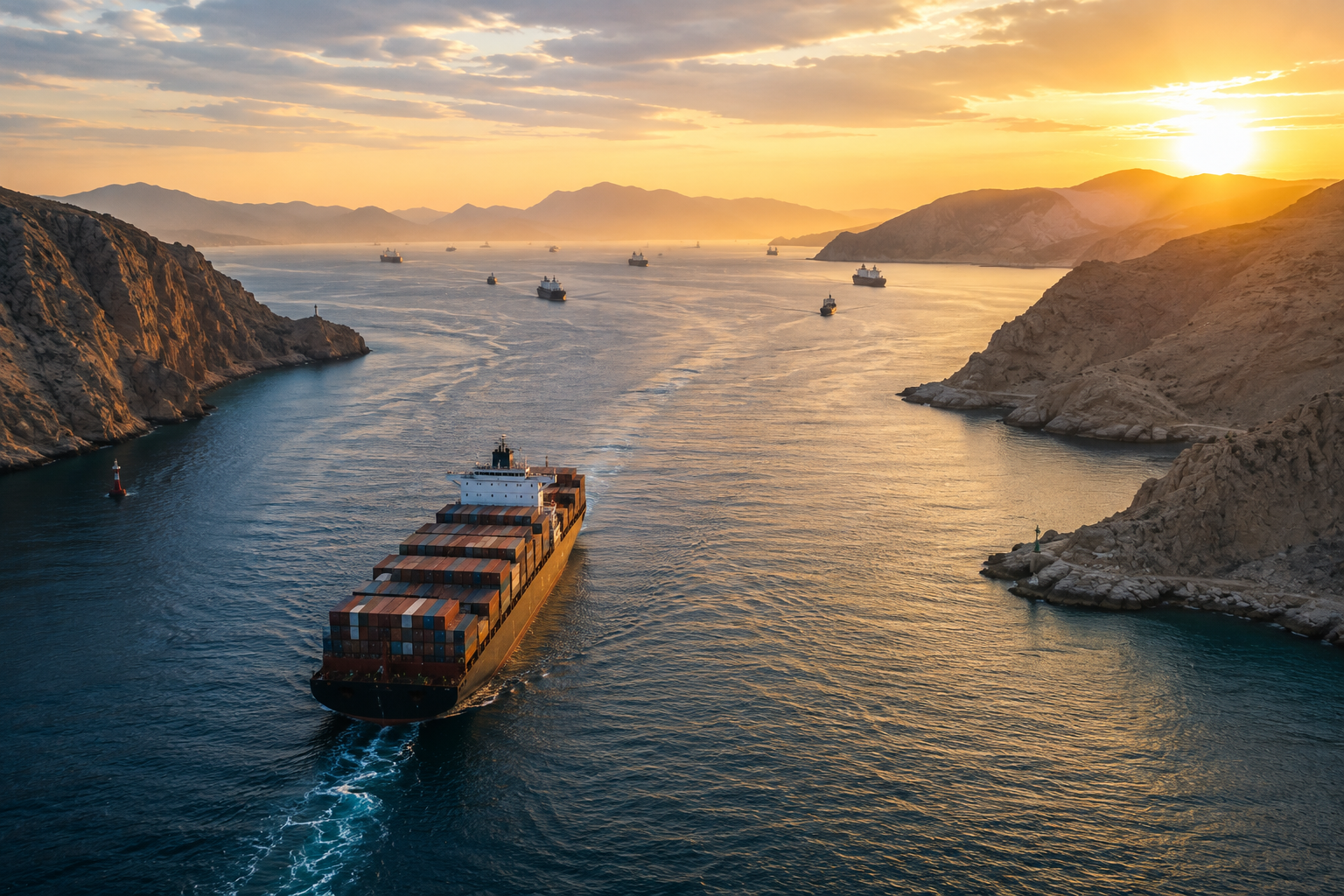
When we think about global trade, we often picture towering container ships crossing vast oceans. What we don’t picture are the narrow stretches of water that make those journeys possible. Yet some of the world’s most important trade routes are surprisingly small.
One of them is the Strait of Hormuz: a narrow waterway between Oman and Iran that, at its narrowest point, is only about 33 kilometres wide.
It may seem insignificant on a map. But economically, it’s one of the most important places on Earth.
A small strait with a global role
The Strait of Hormuz connects the Persian Gulf with the Gulf of Oman and the Arabian Sea. Every day, hundreds of vessels pass through it carrying crude oil, liquefied natural gas (LNG), fertilisers and other essential commodities.
According to the United Nations Conference on Trade and Development (UNCTAD), around one quarter of the world’s seaborne oil trade passes through this single shipping lane, along with significant volumes of LNG and fertilisers. For something so geographically small, its influence is enormous.
Why the world watches so closely
When tensions rise in the Middle East, the Strait of Hormuz almost always makes headlines. Not because every ship stops sailing. But because uncertainty changes behaviour. Shipping companies may choose longer routes. Insurance premiums can rise. Security measures become more expensive. Delivery times become less predictable.
Even if the route remains open, the cost of moving goods can increase simply because the risks have changed. Recent attacks on commercial vessels have highlighted how quickly confidence in major shipping lanes can be affected.
One shipping lane, countless products
It’s tempting to think this is only about oil. In reality, modern economies are deeply interconnected. Oil fuels ships, trucks, aircraft and industrial processes. Natural gas is used for electricity generation and manufacturing. Fertilisers support global food production. When transporting these commodities becomes more complicated or expensive, the effects can ripple through supply chains across the world.
The impact isn’t always immediate. Sometimes it takes weeks or months before higher transport costs work their way through manufacturing, distribution and retail. But eventually, many industries feel the effects.
The hidden cost of going the long way
If shipping companies avoid a particular route, they rarely stop transporting goods. Instead, they reroute. That might mean sailing around the Cape of Good Hope rather than using the Suez Canal, or finding alternative export routes where possible.
Those detours add time. More fuel. Larger crews. Higher insurance costs. Greater wear on vessels. UNCTAD notes that recent disruptions to major maritime routes have forced longer voyages, increasing shipping distances and operating costs while placing additional pressure on global supply chains.
Sometimes the journey changes by thousands of kilometres.
Why it matters in South Africa
South Africa occupies a unique position in global shipping. The Cape of Good Hope has long been one of the world’s great maritime routes. When ships avoid the Suez Canal or Red Sea, many travel around South Africa instead.
That can increase activity around local ports and shipping lanes, reinforcing South Africa’s strategic importance in global trade. At the same time, because South Africa imports fuel, machinery, technology and many consumer goods, it also feels the effects of higher shipping and transport costs elsewhere in the world. In today’s economy, we’re not watching global trade from the sidelines.
We’re part of it.
Shipping is the invisible engine of the global economy
More than 80% of global merchandise trade by volume is transported by sea. Most of us rarely think about that because the system usually works remarkably well. Products appear on shelves. Factories receive raw materials. Businesses deliver orders. The ships keep moving.
It’s only when something disrupts that system that we realise how much the modern economy depends on a handful of strategic waterways.
The bigger picture
The Strait of Hormuz is just one of several critical maritime chokepoints. Others include the Suez Canal, the Panama Canal, the Strait of Malacca and the Bab el-Mandeb Strait. Each plays a different role in connecting global trade. Each has the potential to influence shipping costs, supply chains and delivery times if disrupted. Together, they form the arteries of the global economy.
Looking beyond the headlines
When you hear about rising tensions in the Middle East, it’s easy to think of it as a distant geopolitical story. But often, it’s also a trade story. A logistics story. An energy story. A supply chain story. And ultimately, an economic story.
The world’s economy doesn’t move only because goods are produced. It moves because they’re transported. Sometimes, the most important place in global commerce isn’t a financial capital or a manufacturing hub.
It’s a narrow stretch of water that most of us will never see but one that quietly keeps the world connected.









